Perplexity, intelligence and pretraining corpus mix
Earlier today, I published a blog post showing that if you increase the proportion of code in pretraining, you will get lower log-perplexity in evaluation. This was in response to OpenAI’s blog today.
After publishing, I found a project that had actually randomized contents of pretraining and published log-perplexities on the various components. Basically, they’d already done an experiment to prove the relationship I was alleging.
Here’s the data from their experiment, you can see how closely log-perplexity for code tracks code content.
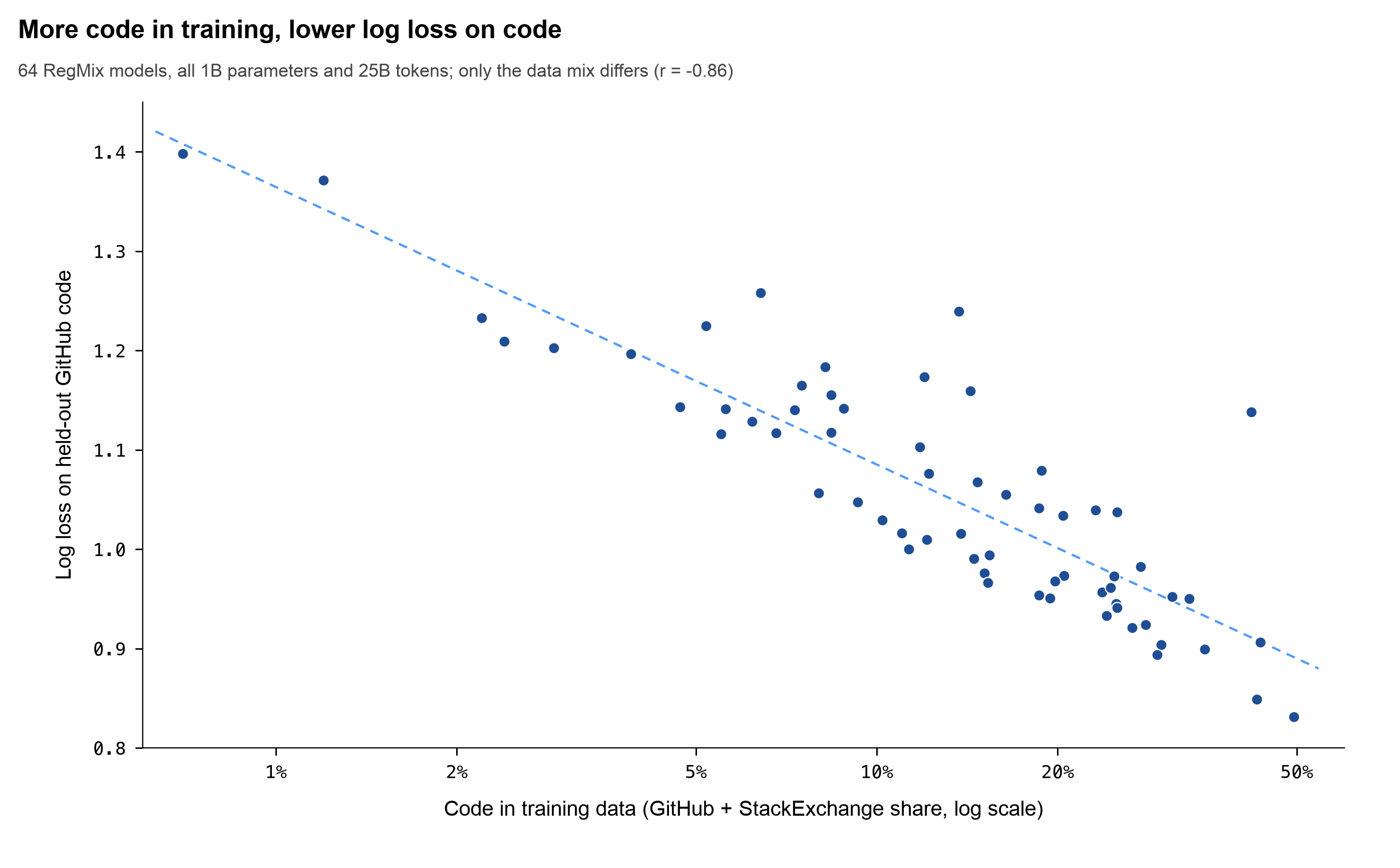
The r² of this chart is 0.75 and the p-value of this relationship is about 4×10⁻²⁰.
For fun, I asked an agent to cherrypick the data and generate a similar chart to OpenAI’s, just using the various points here. We even have an impressive internal model (that’s just 50% code in pretraining).
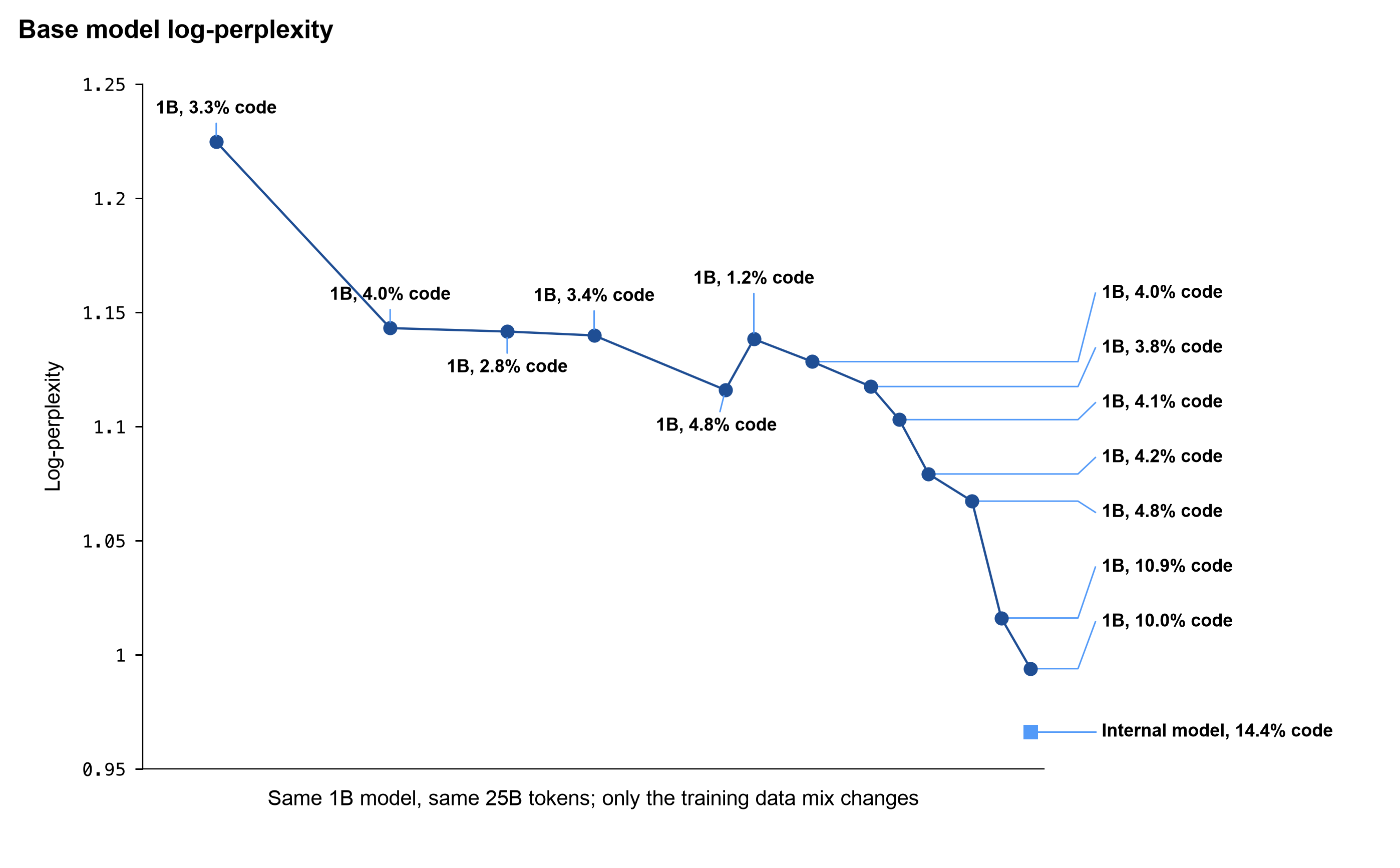
Do we know that OpenAI is increasing the component of code in its pretraining over time? No, but I think it’s a good bet. Can we say that this explains the full drop in log-perplexity? Absolutely not and it’s unlikely. Can we say that there is some confounding here and that OpenAI should have used a more balanced corpus to generate log-perplexity? I think so.